
Applications: [Open / closed status to be confirmed]Deadline [Application deadline]Cohort begins [Start date]
Curriculum

Twenty-four weeks, six phases, one connected body of work.

Nothing here is taught in isolation. Each phase produces one piece of the capstone, so by month six you are assembling your own work rather than starting something new.

A laptop on a plinth showing a live class in progress: the instructor on camera, four students in the sidebar, and a digital marketing lesson on screen with campaign and content panels.
24weeksTeaching weeks
8–10hrs/wkAcademic time
5Portfolio projects
1Integrated capstone

Why the order is what it is

You cannot measure what you have not built, and you should not buy traffic you cannot measure. So the site and the measurement layer come first, organic discovery second, paid acquisition third. Email and analysis come after you have channels producing data, and advanced automation comes last, once you understand the manual process you are automating.

01–04WeeksMonth one

Digital Marketing, website and measurement foundations

You leave this phase with a page that exists on the internet and a measurement setup that tells you the truth about it.

  • The digital marketing landscape, the roles inside it, the customer journey and the funnel.
  • Audience research, positioning and how to write a campaign brief that someone else could execute.
  • Website development introduction: WordPress and Elementor, the HTML and CSS concepts you actually need, and landing page UX.
  • Measurement foundations: Google Tag Manager, GA4, Search Console, UTM discipline and consent concepts.
Project 1 A measured campaign landing page, live, with a documented tracking plan.
05–08WeeksMonth two

Organic discovery

Content SEO follows audience and intent. Technical SEO follows site structure, which is why it sits after you have built one.

  • Search intent, keyword research and how to size an opportunity honestly.
  • On-page SEO, content structure and the copywriting fundamentals that make a page worth ranking.
  • Technical SEO: crawling, indexing, site architecture, schema and Core Web Vitals.
  • How to write an audit that a client or manager can act on, ranked by impact and effort.
Project 2 An SEO audit of a real site with a prioritised content plan.
09–12WeeksMonth three

Paid search

Paid acquisition depends on a destination, a KPI and working conversion tracking. All three now exist, so this is where they get tested.

  • Google Ads strategy and account structure that a second person could understand.
  • Keywords, match types, ad copy, bidding and budget allocation.
  • Landing page alignment: why the click and the page have to make the same promise.
  • Conversion tracking, GTM and GA4 quality assurance, optimisation and reporting.
Project 3 A budgeted Google Ads campaign simulation. You are never required to spend your own money on advertising.
13–16WeeksMonth four

Social media, organic and paid

The strategy is taught once. Then we look at how each platform actually behaves, with Meta as the main practical focus for media buying.

  • Organic strategy for Facebook, LinkedIn and X, including what a content system looks like when one person runs it.
  • Ethical community participation on Reddit and Quora, and why the usual tactics fail there.
  • Meta paid media in depth: structure, audiences, creative testing and measurement.
  • Channel-fit overview for LinkedIn, X, Reddit and Quora advertising, so you can tell a client when not to buy.
Project 4 A four-week content and distribution system plus a paid social campaign brief.
17–20WeeksMonth five

Email, analytics and reporting

Lifecycle automation and serious analysis both need data from real channels, which is why they come after the channels rather than before.

  • Permission, list quality and why a small clean list beats a large dirty one.
  • Email copy, segmentation and lifecycle automation.
  • GA4 analysis, the honest limits of attribution and how to design an experiment.
  • Looker Studio dashboards and reporting that leads to a decision rather than a screenshot.
Project 5 A lifecycle email flow and a decision-ready performance dashboard.
21–24WeeksMonth six

AI systems and capstone

Automation comes last on purpose. You automate a process you already understand, or you automate a mistake at speed.

  • AI automation concepts, APIs and webhooks, workflow tools, quality assurance, privacy and human review.
  • Digital marketing with AI across research, content, SEO, ads and analysis, with the failure modes named.
  • Capstone build sprint, portfolio case study and demo presentation.
Capstone An integrated growth plan, a measurement dashboard and one safe automation.
A note on AI

AI runs through every phase, not just the last one.

In each phase you use AI for a specific, reviewable task: clustering keywords in month two, drafting ad variants in month three, summarising qualitative feedback in month five. Every use comes with the same three questions. What did it get wrong? What did you have to check? What should never have gone into the prompt in the first place?

Month six is where you build systems with it. By then you already know where it fails.

Career labs

Supporting labs, run alongside the main phases.

These are not extra modules and they are not padding. They are short, practical sessions on what sits between doing good digital marketing work and being hired to do it for a remote team.

The skill is what gets you shortlisted. How you present the work, apply, interview and communicate usually decides the rest. None of this guarantees a role, and none of it replaces the marketing itself.

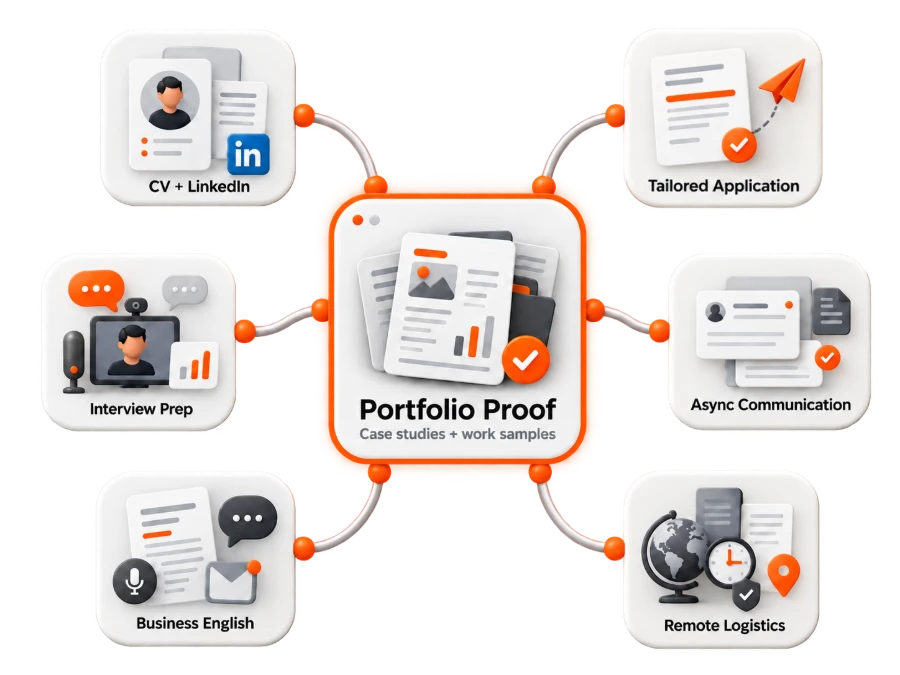
A portfolio of proof at the centre, surrounded by the six things that carry it into a hiring process: CV and LinkedIn, a tailored application, interview preparation, async communication, business English and remote logistics.

Portfolio presentation

Turning a finished project into a case study someone will actually read: the problem, the decisions you made, and what you would do differently.

Remote positioning and applications

A CV, LinkedIn profile and portfolio that make your capability obvious in a minute, and how to read a role properly and tailor an application to it rather than sending the same one to two hundred jobs.

Interview preparation

Talking through your own work in a digital marketing interview: the decisions, the numbers, the mistakes and what you took from them.

Remote team communication

Clear written updates, asking a good question, taking feedback without flinching, documenting what you did, and flagging a blocker early rather than late.

Business English

The written and spoken English that international teams run on, for applications, interviews and everyday work. Clear beats impressive every time.

Remote work logistics

Contracts, payment and payroll routes into Bangladesh, time zones, basic security, and what to check before accepting a remote offer. Including how to tell a real one from a scam.

Weekly rhythm

Where the eight to ten hours go.

This is the academic time only, and the live sessions fall on Saturday and Sunday. If you are on the internship route, add two hours a day from Monday to Friday, ten hours a week for twenty weeks, set out in full on How it works.

Live teaching
2.5 to 3 hours across Saturday and Sunday, taught in real time.
Guided lab, office hours and peer critique
About 2 hours, with the tools open.
Self-study and project work
3.5 to 5 hours on your own build.
Total academic time
8 to 10 hours a week for 24 weeks.
Sample week

What a typical week looks like.

Classes are on Saturday and Sunday. Weekdays are for your own project work, and for the internship contribution if you are on that route. The exact times are not yet confirmed.

The times below are placeholders. The days are fixed: classes on Saturday and Sunday. The exact session times will be confirmed with the cohort dates.
Sample weekly schedule with placeholder days and times
DaySessionLengthWhat happens
SaturdayLive teaching90 minThe core concept for the week, taught live with questions throughout.
SaturdayGuided lab90 minYou build, with the tools open and help available in the room.
SundayPeer critique45 minSmall group review. You give feedback as well as receive it.
SundayOffice hours60 minOptional. Bring whatever is stuck.
Monday to FridayIndependent project work3.5–5 hrsYour own build, submitted against the published rubric. On the internship route the two daily contribution hours sit alongside this.
Tools you will use

Real tools, on your own screen.

Wherever a tool has a free tier, we use it. Where a paid tool is genuinely necessary, it is flagged before the cohort starts so nothing is a surprise.

Build

WordPress, Elementor, basic HTML and CSS

Measure

Google Tag Manager, GA4, Search Console, Looker Studio

Acquire

Google Ads, Meta Ads Manager

Assist

AI tools for research, drafting and analysis, with review [final tool list to be confirmed]

Assessment

You can read the marking standard before you submit.

Every project has a published rubric. You know what a pass looks like in advance, and if you miss it, you are told exactly which criterion you missed and given a route to resubmit.

Assessment is about whether the work would hold up in front of a marketing lead who has to act on it. Not whether you can recall a definition.

Graduation requirements

  • At least 80% live attendance, with a recorded make-up route and a short written reflection.
  • All core labs and quizzes completed.
  • An overall standard of approximately 70%.
  • Five portfolio projects passed against their published rubrics.
  • The integrated capstone passed, with no critical measurement, privacy or safety failure.
  • A demo day presentation, or an accessible recorded equivalent.
  • The code of conduct met throughout.

Academic results are separate from the internship. Your completion certificate is never withheld because of anything relating to your internship contribution. If you complete internship responsibilities, that is recognised separately with an experience letter or reference.

Ready to commit to the six months?

Read how the two routes work, then apply.